How Has Inflation Affected Roofing Costs in Spring, TX?
If you’ve gotten a roof quote in Spring, TX recently and felt a little sticker shock, you’re not imagining it. Replacing a roof in the Houston area costs noticeably more today than it did in 2019, and inflation is a big part of the reason.
As a family-owned roofing company that has served Houston-area homeowners for years, we get this question often. So we want to give you a straight answer: what actually happened to roofing prices in the 2020s, why it happened, and what it means for you if your roof is getting close to the end of its life.
We’ll cover the numbers, the forces behind them (some national, some very Texas-specific), and a few practical ways to plan and budget without getting caught off guard.
How Much Have Roofing Costs Gone Up Since 2020?
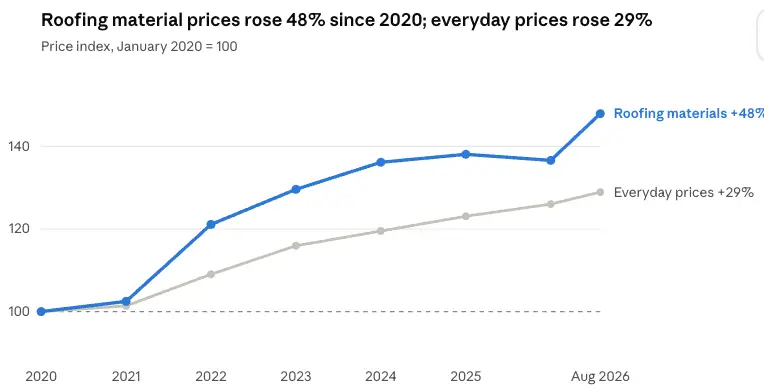
The short answer: the price manufacturers charge for asphalt shingles and roofing materials has risen about 48% since January 2020, while overall consumer prices rose about 29% over the same stretch.
Those figures come from the U.S. Bureau of Labor Statistics. Its Producer Price Index for asphalt shingle and coating materials tracks what manufacturers charge for the products that go on most Houston-area roofs. It sat at 255.2 in January 2020 and reached 377.5 in August 2026. The Consumer Price Index, which measures everyday prices for things like groceries and gas, went from 259.1 to 334.1 over the same period.
In plain terms, roofing materials didn’t just keep pace with inflation. They outran it. A bundle of shingles that cost a roofer $100 in early 2020 costs roughly $148 today, while a typical $100 basket of household goods now costs about $129.
The increases also didn’t happen evenly. Most of the jump came in two waves: a steep climb from spring 2021 through the end of 2022, and a second push in mid-2026.
The dashed line marks January 2020 prices. The gap between the two lines is how much faster roofing materials rose than everyday prices.
Why Did Roofing Get So Much More Expensive?
There isn’t one villain here. Several cost pressures stacked on top of each other, and most of them hit roofing harder than the average household budget.
1. Asphalt follows oil
Asphalt shingles are made from a petroleum byproduct, so when oil and energy prices rise, shingle prices follow. Energy costs climbed sharply in 2021 and 2022, and again in 2026. In May 2026, construction input prices were up 9.6% from a year earlier, driven largely by higher energy costs.
2. Manufacturer price increases, round after round
Shingle makers pass their rising costs along through announced price increases, usually a few times a year. Major distributors like ABC Supply post these letters publicly, and the 2020s have been full of them. In 2026 alone, the major brands announced a round of roughly 4–8% increases effective in April, followed by another round effective June 1. Those increases are cumulative, and shingle prices rarely come back down once they go up.
3. Skilled labor is harder to find
Labor is often about half the cost of a residential re-roof, and good roofing crews are in short supply nationwide. Construction job openings reached 259,000 in April 2026, up 25% from a year earlier, with roofing companies competing for the same limited pool of experienced workers. Industry economists have noted that roofing wages rose nearly 10% from late 2024 into 2025, the fastest of any construction trade. Paying experienced crews fairly is part of doing a roof right, but it does show up in the price.
4. Supply chains, freight, and tariffs
The 2021–2022 supply crunch caused shortages and long lead times on shingles, underlayment, and plywood decking. Since then, freight surcharges and import tariffs on steel and aluminum have raised the cost of the metal parts of a roof system, such as drip edge, flashing, vents, and fasteners. Shingles themselves are mostly made in the U.S., but many of their raw inputs are not.
5. Higher-performance products
Today’s roofs are also simply better than many of the roofs they replace. Impact-resistant (Class 4) shingles, synthetic underlayment, upgraded ventilation, and manufacturer system warranties all add cost, and in the Houston climate they’re often worth it.
What Makes Houston and Spring, TX Different?
Everything above affects roofs nationwide. Homeowners in Spring and the greater Houston area have dealt with a few extra layers on top of it.
Back-to-back severe weather
The 2020s have been rough on Houston roofs. Winter Storm Uri in February 2021, repeated spring hail events across the northern suburbs, the May 2024 derecho that tore through the city, and Hurricane Beryl in July 2024 all sent thousands of homeowners looking for roof repairs and replacements at the same time. Each surge in demand puts pressure on local material supplies and crew availability, which can push prices up for everyone, not just those with storm damage.
Rising insurance costs
Roofing and insurance are closely linked in Texas. According to figures cited by state officials, the average Texas homeowners premium rose from under $2,000 in 2020 to more than $3,500 in 2026. Researchers interviewed by the Texas Tribune pointed to three drivers for Houston specifically: population growth, the rising cost of rebuilding, and stronger storms.
That matters for your roof in two ways. First, many insurers now look closely at roof age and condition when writing or renewing a policy. Second, most Texas policies carry a separate wind and hail deductible, often a percentage of your home’s insured value, so more of a storm-related roof replacement may come out of your pocket than you expect.
Heat that ages roofs faster
Long, hot Houston summers bake asphalt shingles and speed up wear. That means local roofs often reach the end of their useful life sooner than the label suggests, so more homeowners are facing a replacement decision during a period of higher prices.
Where Do Roofing Prices Stand in 2026?
As of the latest government data (August 2026), roofing material prices are at the highest level on record. After holding fairly flat from 2023 through early 2026, the shingle price index jumped about 8% between April and August 2026 as the spring and summer manufacturer increases took effect.
Will prices come back down? We’d love to tell you yes, but the honest answer is: probably not by much. Looking back over the past several decades, roofing material prices have occasionally dipped for a few months, but they have not returned to earlier levels after a big run-up. Each round of increases tends to become the new baseline.
That doesn’t mean you need to rush. A roof replacement is a big decision, and the right time is when your roof actually needs it. But it does mean waiting for prices to “go back to normal” usually isn’t a winning strategy, especially if a worn roof is putting the rest of your home at risk.
What Can Spring Homeowners Do About Higher Roofing Costs?
You can’t control the price of oil or shingles, but you can control how prepared you are. Here’s what we’d tell a friend or neighbor.
Get your roof inspected before there’s a problem. Catching a loose flashing detail or a few damaged shingles early is far cheaper than dealing with a leak, rotted decking, or interior water damage later. A small repair today can buy you years before a full replacement.
Know your roof’s age and your insurance policy. Pull out your policy and check two things: your wind and hail deductible, and whether your roof is covered at replacement cost or actual cash value. If your dwelling coverage hasn’t been updated in a few years, ask your agent whether it reflects today’s rebuilding costs.
Plan ahead instead of waiting for an emergency. If your roof is 15 or more years old, start budgeting now. Replacing a roof on your own timeline lets you compare options calmly, rather than making a rushed decision after a storm when every roofer in town is booked.
Ask how long a quote is good for. With manufacturers raising prices more than once a year, many contractors only hold pricing for a limited window. It’s a fair question, and a good roofer will give you a straight answer.
Consider impact-resistant shingles. Class 4 shingles cost more upfront, but many Texas insurers offer premium discounts for them. Ask your agent what discount you’d qualify for before you decide.
Be wary of the lowest bid and the door-knocker. After big storms, out-of-town “storm chasers” flood Houston neighborhoods with low prices and high pressure. A rock-bottom quote often means cut corners, like reusing old flashing or skipping proper underlayment, that cost far more down the road. Look for a local company with a physical address, manufacturer certifications, and a track record you can verify.
The Bottom Line
Inflation has made roofing in Spring, TX and across the Houston area noticeably more expensive in the 2020s. Materials have outpaced general inflation, labor is tighter, and Houston’s storms and insurance market add pressure of their own. Prices are unlikely to drop back to 2019 levels, but with good information and a little planning, you can still make a smart, unhurried decision about your roof.
At RCI Roofing, we’re a family-owned Houston company, and we’d rather help you plan than push you into anything. If you’re wondering how much life your roof has left, we offer free, no-obligation inspections. We’ll tell you honestly whether you need a repair, a replacement, or nothing at all right now. As a GAF Master Elite contractor for over a decade, we hand-nail every roof, and if your decking needs attention during a replacement, up to three sheets of plywood are on us.
Whenever you’re ready, we’re here to help.
Sources
- U.S. Bureau of Labor Statistics, Producer Price Index: Asphalt Shingle and Coating Materials Manufacturing, via FRED, data through August 2026
- U.S. Bureau of Labor Statistics, Consumer Price Index for All Urban Consumers, via FRED, data through August 2026
- ABC Supply, Manufacturer Price Increase Announcements: Steep Slope Roofing
- Roofing Contractor, Construction Job Openings Surge Amid Roofing Labor Crunch (June 2026)
- Roofing Contractor, ABC construction data coverage (June 2026)
- Roofers Coffee Shop, Roofing Leads the Way as Wages Create Pressure for Construction
- Beinsure, Texas Orders Insurance Reforms as Homeowners Premiums Rise (August 2026)
- Texas Tribune, Houston insurance costs after Hurricane Beryl
