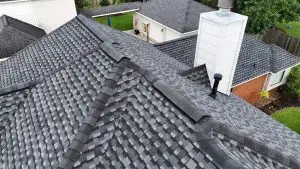
If you’ve ever looked closely at the peak of a roof and noticed a low-profile strip running along the very top, that’s likely a ridge vent. It’s one of the most important components of a well-functioning roof system — and one of the least understood.
Start with the problem it solves
In Houston, attic temperatures routinely hit 140 to 160°F on summer afternoons. That heat doesn’t just sit there — it degrades shingles from the underside, strains your air conditioning system, and shortens the life of your roof significantly faster than the manufacturer’s warranty assumes.
The solution is moving that hot air out before it does damage. That’s exactly what a ridge vent does.
What a ridge vent actually is
A ridge vent is a ventilation channel installed along the entire length of the roof’s peak — the ridge. During installation, a slot is cut into the roof decking just below the peak on both sides. The ridge vent covers that slot, allowing hot air to escape continuously along the full length of the roof while keeping rain, debris, and pests out.
It works as part of a system. Cool air enters the attic through soffit vents at the eaves — the lower edges of the roof. As that air warms, it rises naturally and exits through the ridge vent at the top. This continuous airflow is called passive ventilation, because it requires no mechanical assistance. It runs 24 hours a day, driven by nothing more than the basic physics of warm air rising.
Why the full length matters
Some older homes use box vents or turbines — individual ventilation points placed at intervals across the roof. These work, but they only exhaust air from the area immediately around them. Hot air pockets can form between vent locations, particularly on larger or more complex roof layouts.
A ridge vent exhausts air along the entire peak simultaneously. Every part of the attic has a direct, short path to the exit point — which means more consistent temperatures, less trapped heat, and more even performance across the whole roof system.
What goes over the ridge vent
Once the ridge vent is installed, ridge cap shingles go over it. These are purpose-made shingles that cap the peak of the roof and shed water away from the vent opening while still allowing airflow through. From the street, a properly capped ridge vent looks like a clean, finished roofline — you wouldn’t know there’s continuous ventilation running underneath it.
At RCI Roofing, we install ridge vents with sealer ridge cap as a standard part of every full replacement. It’s part of how we make sure the roof we put on your home performs the way it’s supposed to for its full lifespan — not just for the first few years.
Signs your current attic ventilation isn’t working
- Upstairs rooms that stay noticeably hotter than the rest of the house
- Energy bills that seem high relative to your square footage
- A roof that’s aging faster than expected for its age and material
- Dark staining or moisture on attic rafters or decking
- An attic that feels like an oven when you open the access door in summer
Any of these are worth having looked at. Poor ventilation is one of the most common causes of premature roof failure in Houston — and one of the most fixable.